Archive for May, 2008

Kimchi Ramen ( 김치 라면) is one way to cook delicious Korean ramen. There are many different kinds of Korean ramen in the Korean or oriental store. Most Korean ramens have more flavor and they are spicier than American ramen. Adding kimchi in normal ramen gives even more flavor and makes it more spicy. I love kimchi ramen. However, ramen is not very healthy, so I want to recommend not eating this yummy food too often. I know it is not easy to avoid this temptation. hehe I hope you will try Korean kimchi ramen someday.:D

Read the rest of this entry »


Spicy Fried Fish Cakes

Odeng Bbokkeum (오뎅 볶음) is a Korean side dish. Odeng means fish cake and Bokkeum means fried. In the past, most Korean students brought their own lunch box to school everyday since schools didn’t have a cafeteria like nowadays. Odeng bokkeum was one common side dish for our lunch box, because of that, it brings back memories of our school days. It is also a common side dish for homemade meals. If you like spicy food you can add more red pepper powder. Keep this side dish in the refrigerator and serve it with rice. I hope you enjoy this food. *^^*

Read the rest of this entry »


Ddeokggochi (떡꼬치) is a popular Korean street food. It is very popular with children, and I used to eat this after school with my friends. The taste is spicy and sweet. Enjoy this great Korean snack.

Read the rest of this entry »

Soy Sauce (간장=GanJang)

Posted by: Aeri Leein Ingredients in Ingredients
3
May

Soy sauce

Korean soy sauce, (called Joseon ganjang=조선간장, in Korean) is a byproduct of the production of doenjang (Korean fermented soybean paste). Joseon ganjang, thin and dark brown in color, is made entirely of soy and brine, and has a saltiness that varies according to the producer. Traditionally in Korea, we have different kinds of soy sauce, depending on the length of the fermentation time. Basically we use 2 types of soy sauce the most. One is normal soy sauce, which is fermented for more than 3 years. The other is soup soy sauce which is fermented for 1 or 2 years. The longer you keep the soy sauce the darker color, and the stronger flavor. Nowadays, many Korean people just buy soy sauce from the store instead of making it at home since it is difficult and time consuming.
Read more from Wikipedia…

  • Use:
    Seasoning, Sauce

  • Storage:
    Keep in the cabinet.

  • Brand:
    I highly recommend the Korean brand of soy sauce called
    “Sam Pio.”

  • Short Korean lesson: *^^*
    GanJang (간장)=Soy Sauce


This is Sempio organic sesame oil. In Korea, you can buy sesame oil in any grocery store, but many moms like to make their own sesame oil at a mill. Before doing so, they will check the quality of the mill’s seeds first or they will bring their own seeds to make sure that only top quality seeds are used to make their oil. The check the seed quality for two reasons: for health (organic, etc.) and for better taste. Since moving to the USA, I have not had good sesame oil, but oh my, when I tried the Sempio brand of sesame oil, I can see why it is called organic. I liked the flavor, and changed the taste of my dishes in a good way. It is close enough to the one I missed from Korea. I’m not sure about the price, I just guessing it will be a little more expensive than others because it is organic, but I would like to buy this the next time. I’m happy to find a good product in that point. :D

Sesame Oil

Sesame Oil

Sesame oil (also known as gingelly oil or til oil) is an edible vegetable oil derived from sesame seeds. Besides being used as a cooking oil in South India, it is often used as a flavor enhancer in Taiwanese, Korean, and Southeast Asian cuisine. Sesame oil contains high proportion (41%) of polyunsaturated (Omega-6 fatty acids.) It also has natural antioxidants. Light sesame oil has a high smoke point, and is suitable for frying, while heavy (dark) sesame oil (from roasted sesame seeds) has a low smoke point, and is unsuitable for frying, instead being used sparingly for seasoning, particularly in East Asian cuisine.
Read more from Wikipedia…

  • Use:
    Seasoning

  • Storage:
    Keep in the cabinet.

  • Types:
    Korean Brand Name:
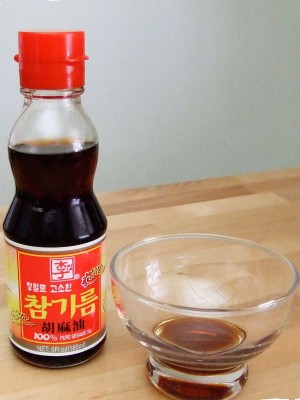
    “李씨네” (First Picture) – A little better than “Assi” for flavor, but it is not the best.
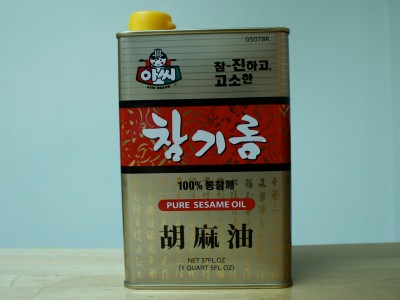
    “Assi” (Second Picture) – So so (It is a little too strong, and has a fake sesame flavor in it.)

  • Short Korean lesson: *^^*
    Cham (참)=Real
    GiReum (기름)=Oil