
There are many different kinds of kimchi, and Koreans eat kimchi everyday. There are even songs about kimchi such as “I Can’t Live Without Kimchi.” Moms love to have a good kimchi refrigerator. Today I will post the most common kimchi, “napa cabbage kimchi.” Kimchi is a dish of fermented vegetables with various seasonings. It is a traditional dish in Korea.
Yield: 1 Gallon
Short Korean Lesson
- SutGaRak (숟가락) = Spoon
- JeotGaRak (젓가락) = Chopsticks
Video Instructions
Main Ingredients
- 1 Large Napa Cabbage (4 lb)
- 2 Cups Korean Radish
- 1 Cup Garlic Chives
- 5 Green Onions
- 1 Onion
- 2 Hot Peppers
Brine Ingredients
- 10 Cups Water
- ½ Cup Coarse Sea Salt (For Salt Water)
- ⅔ Cup Coarse Sea Salt (For Sprinkling)
Sauce Ingredients
- 2 Cups Water + (3 Tbsp Water and 3 Tbsp Sweet Rice Flour)
- ¼ Sweet Apple + ¼ Onion
- 1¼ Cup Red Pepper Powder for Kimchi
- 1 to 2 Tbsp Sugar
- ¼ to ⅓ Cup Fish Sauce
- 3 Tbsp Minced Garlic
- ½ Tbsp Minced Ginger
- ½ Tbsp Salt
- 2 Tbsp Sesame Seeds
Directions

Remove any bad parts from the napa cabbage.
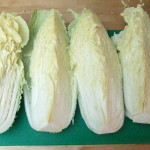
Divide the napa cabbage into 4 pieces. Some people divide it half, but I prefer 4 pieces, since 4 pieces are easier to put in a jar and cut later.
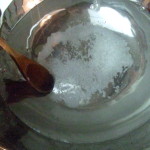
In a huge bowl, combine 10 cups of water and ½ cup coarse sea salt to make salt water. Stir until the salt is dissolved.

Prepare ⅔ cup coarse sea salt. Divide the salt evenly for 4 pieces of cabbage. Sprinkle the salt inside each leaf. Put more salt on the thicker parts than the thinner parts. This step is important to make kimchi. The right amount of salt and time to marinate the cabbage will change the results of your kimchi.

Dip the cabbage in the salt water. Put some heavy thing (like a big pan full of water) on top of the cabbage to keep them under the brine. That will help the cabbage to get salted better. Leave it for 4 to 5 hours until the cabbage leaves become a little soft.

Rinse the salted cabbage twice in water.

Drain the water, and set it aside for about 2 hours until more of the water drips out: or you can squeeze the water out.

Mix 3 Tbsp of sweet rice flour and 3 Tbsp of water.

In a pan add the mixture and 2 cups of water. Boil it until it makes bubbles on medium. Keep stirring it so that it will not stick to the bottom. It took about 10 minutes for mine.
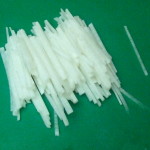
Cut the radish very thinly into 2-inch lengths.

Cut 5 green onions the same length as the radish.

Cut the garlic chives into 1½-inch Pieces.

Cut 2 hot peppers thinly and slice ¾ of an onion thinly.

Grind ¼ of an onion and ¼ of a sweet apple.

In a big bowl, add the rice flour mixture, 1¼ cup of red pepper powder, and 2 cups of radish. Mix everything together.
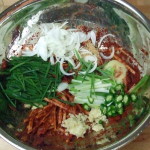
Add the rest of the ingredients: chopped onion, hot peppers, garlic chives, green onion, onion & apple mixture, 1 to 2 Tbsp of sugar, ¼ to ⅓ cups of fish sauce, 3 Tbsp of minced garlic, ½ Tbsp of minced ginger, and 2 Tbsp of sesame seeds. Mix all of the ingredients well. Taste it and salt it to your tastes. I added ½ Tbsp of salt.

Spread some of the mixture into each leaf of the cabbage. Make sure all of the surfaces get covered in the sauce.

Wow! At last, it is done! 😀
I prefer to use a glass jar to keep kimchi since the kimchi has a strong smell. It is easier to remove the smell from glass jars than from plastic containers, and glass helps to contain the smell. 😉 Keep the kimchi at room temperature for about a day, and then put it in the refrigerator. You can eat kimchi before it is fermented, but it tastes best when it is properly fermented. (In about 1 week, depending on your refrigerator’s temperature.) Even old (sour) kimchi can be a delicious dish if you cook it and make: fried kimchi rice, kimchi dumplings, kimchi jeon, Kimchi soup, and etc. Enjoy! 😀
Tips for delicious kimchi: *^^*
- Good ingredients are important, especially the Red Pepper Powder and Napa Cabbage.
- Getting the right amount of salt for marinating the napa cabbage in the salt water is very important. You don’t want the kimchi to be too salty, but if it doesn’t have enough salt, it becomes sour too quickly, and it produces too much juice later. Use coarse sea salt, not normal salt.
- Depending on your personal tastes, it is good to add raw oysters or salted shrimp (SaeUJeot) also.


Another GREAT recipe and I loved your explanation & tips. I’ve always wondered what to do with older kimchee and it never occurred to me to make kimchee fried rice which I usually go OUT to eat for because it’s such a favorite food, too. I can’t wait to see your other kimchee and recipes. It reminds me of my high school best friend who’s mom would cover the table with banchan which included many, many kinds of kimchee…..such a treat for this ilbonsaram!! Thank you , Aeri!!
Hi, Eric
Now, I can remember your name. Thanks for all these kind comments !!! Yes, I will post different kinds of kimchi later. Have you ever tried green onion kimchi ?? it’s one of my favorite..hehe oh..so you are a Japanese ?? ilbonsaram..hehe that was cute Korean word !! thanks, Eric !!!
Finally its out!!!!! I have been waiting this for years!!! Delicious!! Sis, thanks for the goodest explanation in the world! I will make one soon , but first, i really need to get the best ingredients! Thank you so much for this sis!! I appreciated all your hard work! Miss you! Muakx! have a great day!!
Hi, ChuiYew
I saw your necklass and earings.. good job !! I know you put lots of time and effort, I wish you good luck !! 😀 Thanks for comment !!
thanks unni!!! XD i missed talking to you!! I hope you have a nice day!! love you!
Hi, ChuiYew
I just came back from it I told you this morning !! It was fun as always ~~~ hehe.. Yep..I hope we can talk longer next time ~~ thanks ..
Unni i making this tomorrow !!!!!! but my laptop spoiled , remember? now i am printing everything out for me to refer.. if i have my lappy, i can refer it right away..T___T too bad for me.. by the way, just wish me luck for doing this, i scare i failed again!! T___T and if possible i will post it out to let you see! Have a nice day! hope to chat with you soon! MUAKXXX
[WORDPRESS HASHCASH] The poster sent us ‘0 which is not a hashcash value.
Hi, ChuiYew
Yep..I’m crossing fingers for you. 😉 Let me know the result !! okay ??
this looks SOOOO much easier than Maangchi’s version. i’m going to have to try this since i am going broke buying my kimchi from the store. 🙂 i like to put this on my hamburger. 🙂 it’s really good.
btw, you have been busy posting recipes while i’ve been gone!!!! i have SO MUCH to catch up on 🙂 you are doing great girlfriend!! i am so proud of you. 🙂
Hi, farleen ^^
Yes, if you make your own kimchi, you can save money..even it’s lots of working and time consuming. oops.. haha..kimchi with hamburger.. great !! Thank you !! Yep.. I hope I can catch up all the requests I got so far..hehe I love your comments..thanks again. 😀
Your website’s really interesting.I started to have Korean food 4-5 yrs ago especially Kimchi’s my favorite.Unfortuanately I stopped eatting beef and pork over 10 years so it was hard to enjoy the ther food.However, I’ve been making Kimchi for a while but I’m not happy with it yet. Anyway I’ll try your recipie and other food, thank a lotxx
Hi, lunar
I’m very happy to meet you !!!
Wow.. it’s great that you like Korean food. Actually.. there are more vegetable Korean dishes..just I’m posting recipes that I got request from other people..so there are many main meat dishes. I will try to post more dishes not using beef or pork..hehe Be honest, I think it’s difficult to make a good kimchi.. I’m also learning and testing to get a good recipe.. I’m not 100% happy about this recipe that I posted.. so someday.. if I make really good Kimchi, (Maybe I have to learn from my mom in person when she visits to America ) I will definitely post it again. Thanks !!!
Hi Aeri,
Just finished making kimchi, have to wait for a week. Would you mind telling me how much 1 cabbage weigh?. sorry, if it was a strange queston but the cabbages in my country are tiny or even big but they are light so I can use it next time. I’ll write to you again how my kimchi turns out. Thanks Aeri
Hi, lunar
Oh.. you made kimchi.. I hope your kimchi turn out good. I forgot to weight the cabbage when I made this post..(That happens sometimes.. since I have to do many things at the same time..) sorry… as my recipe says.. It filled all in 1 gallon glass jar. I guess..it was 14 inch lengh and 8 inch width.. When I get the cabbage again..I will measure the weight. sorry again.. Other people might have some question.. so thanks for good question !!!
Thanks Aeris! Will try this one this weekend. Will let you know of the result in a weeks time. I know this will turn out great! 🙂
Hi, jhny69
I’m not 100% confidence about kimchi recipe..but I hope it turns out good.. hehe Thanks !!! 🙂
Well know in a week, already finished making mine. I’ll let you know in a weeks time… hehehe
Hi, jhny69
Yep.. let me know the result..
thanks !!
Hey, Aeris… Well it didn’t turn out what I expected it to be, but it was still very good. My family devoured it already and I’m now making another batch… thanks for the recipe…
Hi, jhny69
^^ good it was okay~~~
wow.. you are making another batch ??? Next year.. when I get baby.. my parents will visit USA… then I will learn how to make Kimchi from my mom..and get good recipe.. then I will post a better kimchi recipe.. okay ?? thanks ~~~ 🙂
Hi! Aeris, question, i just finished making my Kimchi yesterday. It has been fermenting for over a day. But it seems too “wet” inside the jar. there’s just too much liquid. is that normal?
Hi, jhny69
It depends on .. how well you drained the salted water from the cabbage before you add the sauce…but don’t worry.. the kimchi usually gets liquid.. too much..hm.. I don’t know how much you had.. but it will be okay.. thanks ^^
I actually drained it for more than 2 hours… kinda like 10 hours or more… coz I forgot about it… hehehe… I’ll send you a photo coz your a better judge than me. thanks!
Hi, jhny69
Your kimchi is okay ?? ^^;;
Hey Aeri,
Today I have tried to make Kimchi for the very first time based on your recipe. I am so excited haha. I didn’t had quite a few things, so I had to use a bit of substitute creative ingredients :). I didn’t had chives, radish so I didn’t add them. And I also didn’t had the Korean red pepper powder, so I substitute the red pepper powder for Turkish red pepper flakes. (now runs ,lol). I did had hot pepper paste at home. So I had added a tablespoon of it in the sauce to have at least a little hint of the real hot pepper powder in the kimchi. I am not sure if that was really a wrong thing to do. I hope it doesn’t affect the fermentation.
I skipped the part to let the cabbage set for 2 hours. Instead I used a salad spinner. I think it worked, the kimchi doesn’t look watery.
I am a little scared about the fermentation. How can I tell it is properly fermentated?
Thank you so much for sharing the recipe and the detailed information:).
Hi, Poeh
Haha… I smiled while I was reading your message. Though you didn’t have many ingredients for kimchi you needed.. I think… you made it work. I hope the taste is okay also. Usually it takes about a week or more than that depending on the temperature to be fermented.. usually you know that by tasting it. Thanks !!
Hi Aeri.
I’d liketo let you know that finally my Kimchi’s done. I actually made double of your recipe which I could see my cabbges were not enough as I questioned before about the weight, however, the suace was too much but the color was so beauty. Because of making a lot everytime (I found that no matter make more or less I spend the same time and energy) I always give away to my friends which I hope to hear comment soon because they’ve been testing different recipe for a while. I can’t imagine if I really use sweet rice flour how it would be, but I will definietly use your recipe from now on, by the way I also made radish kimchi last Sat. so….excited. thank you Aeri for giving us all the good recipe
Hi, lunar
Oh~~~ so you like your kimchi.. phew~~ That’s good.. since I’m not 100% happy about this recipe… I’m still trying to make better recipe for kimchi… but I’m happy you liked it. later I will post more kimchi recipes.
Thanks again !!!
WoW! Thats great can’t wait for it… thanks Aeri…
Hi, jhny69
You are ve~~~~~ry welcome..hehe
Thanks 🙂
Aeri, I hope you remember me… I’m lovetohavefungirl from YouTube.. I haven’t messaged you in a while.. Anyway, I made this recipe before, and my husband said it was very good. I was so surprised because I heard it was hard even for Korean people to make Kimchi.. anyway, I made it again today.. I think I actually did better this time.. Also, I don’t have garlic chives.. so I put a little more green onion and garlic.
Hi, Jacqueline
Of course I remember your name from Youtube. Good to see you again. Wow.. you tried to make kimchi and your husband liked it??? awesome !!! yes.. You did a good job to substitute the garlic chives to more green onion and garlic. Enjoy your kimchi..and thank !!! Hope to see you more often. 😉
Hi Aeri,
Thank you so much for sharing this recipe. I tried making it yesterday and it turned out very very well!! It resembles a lot to the one I used to buy from Hanahreum (Korean store). I’d been using this recipe which uses little red powder and that doesn’t require the kimchi porridge (flour&water) so it had always been watery and not as tasty. Anyhow, I found out yesterday that there was a lot of ‘leftover’ sauce even after the cabages have been fully stuffed with the mixture. I used one big (5 lbs) napa cabbage and soak it in the same amount of salt as stated here. But I realized that in the end the cabbage became very wilted and shrunk in size. I end up with only a half gallon of kimchi.
How many pounds of cabbage did you use for this recipe? If next time I’d like to use more cabbage (say, 8 pounds) for the same recipe for the sauce, should I put more salt in the water?
Thanks alot again, Aeri. :)) I’ll be looking forward to your response. God bless you!
Hi, Fran
Thank you very much for your comment. Oh.. I’m sorry that I didn’t tell exact size of the napa cabbage. Usually.. we cook with feeling.. don’t measure exact thing in Korea. So.. when I post recipes.. I write down how much I used for the food.. unfortunately, for this recipe.. I forgot to measure the weight of napa cabbage. When I get a chance to make kimchi again.. I will definitely weight it..and edit the recipe. sorry for poor answer.. the salt amout is depending on your water amount.. so if it’s same amount of water..I don’t think you need to add more salt in it.
you can use the leftover mixture to make kkadugi, raddish kimchi. aeri has a recipe for that. just follow that but use this mixture. ^hope this will help you. you think so, aeri?
forgot to add that usually you’ll have leftover radish after making cabbage kimchi.so might as well use this to make raddish kimchi too. just cut it in cubes and follow aeris’s instruction for your raddish’s preparation but use those leftover mixtures instead.
hi, layping
hehe… yep you are right layping..
thanks for answering a good answer for him. 🙂 You are an expert of Korean food. hehe very proud of you.. 😉
Hi Aeri!!! You explain the step perfectly and not to complicated to understand.
Ohhh thank you so much!! I love Kimchi!!
I am going to make some this weekend and hopefully it will taste great…
Again thank you very much~~GO GO GO!! ^_^
Hi, Katrina
I’m very happy to read your comment. I hope your kimchi turns out great also. Enjoy ~~~~ 🙂 Thanks !!!
Hi Aeri,
Love love your blog and have tried several recipes very successfully. I am dying to try this; however, I cannot for the life of me find garlic chives. What would a good substitute and what quantity. Thanks!
Hi, Alethea
aha… yes.. sometimes it’s difficult to find garlic chives..I have same problem.. okay.. use more green onion instead of garlic chives. I said 5 green onions for this recipe.. maybe you can use 8~10 green onions instead. Thanks !!! 🙂
you can grow garlic chives. they sell the seeds at walmart & places like lowes & stuff. just put them in a pot & stick them outside & don’t forget to water! if you cut them, instead of pulling them up, they will regrow within a few weeks. 🙂 you can plant more than one package, though, and put them in different pots, that way you have a steady supply of garlic chives. they’re very easy to grow, even if you live in an apartment! 🙂 just as long as you have a sunny place to set the pot you’re growing them in! 🙂 if indoors, make sure there’s a fan nearby. if you put a fan on low, it simulates wind & makes them stronger. 🙂
hi misspookietoodle,
Very good information..
I didn’t know that you can buy the garlic chive seeds at walmart or lowes..hehe great.. thanks
Honestly, I have never in my life heard of this dish, but it does sound delicious. I love the cultural background you give as well.
Hi, Online Classes
Oh.. you never heard of it ?? ^^ I’m happy that you know it now..hehe thanks !!!
Yeah, I’ve never heard of it before but I will definitely have to try it. All of your recipes sound delicious. Keep up the good work.
Hi, Online Classes
Yes.. I will try to keep this work. Thanks !!!
Hi Aeri,
Could you teach us how to make cucumber kimchi… or was it called stuffed cucumber or something like that… tried it in a korean restaurant as a side dish… it was great… thanks!
Hi, jhny69
aha.. you are talking about “Oi SoBakee” ?? Okay..I will add it to the list.. hehe thanks 🙂
Hi Aeri
I’ve just found your website and I’m making your kimchi right now! BaeChu kimchi is my favourite (its my husband’s favourite treat too), but this is the first time I have made it. I couldn’t find the chives, so I added more onions like you suggested instead. I have lots of daikon left over – do I have to salt the daikon for 5 hours too? Thanks and I will send you a photo of my kimchi when its done!
Hi, Sadie
Nice to meet you !!!
wow.. I hope your kimchi turns out great. Yes.. greenonion or onion can be good as a substitute garlic chives.. I have a recipe for radish kimchi also. You can use your daikon for it. You can find it in my picture index. Thanks !!!
P.s I will be so happy to see your kimchi picture. 🙂
I made this kimchee and it looks so good right now. I’m going to wait a bit to eat it. I love your recipes and youtube videos, Aeris. Keep up the wonderful work. Best wishes to you and your expanding family.
In the future, after you get your rest, I would love for you to do a product video. There are so many brands of pepper powders (fine and course), hot pastes, soy pastes.. etc. If you can recommend what you prefer, that would be wonderful.
hi moomoo,
Thank you very much for your kind comment. I hope your kimchi turns out great. 🙂 Oh… yes.. I was thinking to do a video for products I use a lot for Korean cooking. Thanks for good suggestion. 🙂
hai aeri.i just try your receipe for bae chu kimchi. can i put the kimchi in the refrigerator after i finish made the kimchi.. i forgot about 1 day in room temperature.. izzit ok?i havent try it yet. its only for a day.. sweet rice flour is glutinous flour? thxx aeri for the baechu kimchi receipe..
Hi rasmi lee,
Yes, it’s okay if you forgot to leave it..just it will take longer to get fermented.. Yep.. sweet rice flour is glutinous flour.. I hope your kimchi turns out great.. thanks
Hi Aeri,
Two weeks ago, I tried this recipe. Quite delicious but it is too sour for my mum’s taste. Had rinse the cabbage thrice in water as it was too salty. Is this why the kimchi is too sour?
Hi Aeri,
I have tried this recipe two weeks ago. It is delicious but too sour for my mum’s taste. Have rinse the cabbage thrice in water as it was too salty. Is this the reason why it turn out too sour?
hi Catherine,
Usuallly.. if the cabbage isn’t salted enough… the kimchi fermented faster … so I guess that’s the reason.. in Korea.. for winter kimchi which we keep for a long time to eat for the winter.. we make the cabbage very salty.. but if we are going to eat in short time.. use less salt than the winter kimchi.. thanks 🙂
Hi Aeri Uhnni,
I’m a big fan of your recipes!
I was hoping to use SaeUJeot in your kimchi recipe. I was wondering how much and when I should use it in your recipe. Thanks for your help!
hi Ellen,
^^ thanks..
grind the saeujeot with the onion and apple.. maybe 1/2 tbsp depending on how much flavor of it you want for your kimchi..and that case.. reduce the fish sauce amount.. when you make it.. taste the paste…and adjust the saltness with salt or fish sauce.. thanks
Hi Aeri!
I used this recipe but I cut the napa cabbage (like in your “Easy” recipe) I think I bought too many Korean radish but it’s delicious!!!
Hi, Aeri
I’m going to make Kimchi for the first time with your recipe. Do you think is OK to use a Korean Pear instead of the sweet apple? Thank You!
hi Cler,
Yes you can use Korean pear instead.. thanks ^^
Hi Aeri,
Will the kimchi still taste good if I add half an apple instead of 1/4 and maybe 10 cloves of garlic instead of just a few spoons? Also I like really spicy food so can i put more gochugaru? Thanks!
hi RedRanger123,
Yep.. you can always adjust the amount of ingredients depending on your taste. if you add more apple.. you can reduce the sugar amount.. ^^ thanks
Hi Aeri,
Sorry, I have one more question:) Can this recipe be done with two small/medium cabbages cause this one is done with one large baechu. Thanks!
hi RedRanger123,
Yep. you can do that.. thanks 😀
Hi Aeri~
I want to try making kimchi this week end, and in order to have the right amount of salt, could you tell me how much a cup of salt weight?
I’m a great fan of your recipe ^^. actually I’m a little bit scared of doing it because all my korean friends told me that it was too difficult and that even their mom werent able to make it -_- (freaking out). but i’ll try to make it as good as I can, thanks to you.
Keep up the good ^^ hope all ur family is doing good.
inès from france ^^
hi Inès,
Yes, making good kimchi can be difficult..but if you keep try again and again.. it will be easier and better to make it. sorry but what is your question about salt ?? i mentioned the amount of salt in the recipe.. so what did you mean ??
Hi
I just wanted to know what was the weight of a cup of salt in gramme. In France we don’t use cup but gramme instead, that’s why.
But I did it the best I could so even if it’s not good I’ll be proud (and a little bit disapointed, I must admit)
Thanks for your recipe
hi Inès,
Aha..I got it..
1 Cup of salt is.. 175 g with my scale.. it was coarse sea salt
Hi Aeri,
Just made this kimchi today and it turned out perfect! First time I used apple (I have used korean pear before) but this is delicious! Perfect balance of sweet and salty. I have been hunting for the perfect recipe and this is it.
hi csyama,
AWESOME !!! 😛 thanks
Hi! I made my first Kimchi today and it tastes great! Thank you for your detailed recipe and video…it really helped me a lot!

Now I will also try out other things 🙂
캄사함니다!!!
hi 조야 ^^
Your kimchi is fermented yet ? hehe Thanks for your comment. please give me more comments about your Korean cooking.
Is a kimchee refridge different than a regular fridge? 🙄
hi Maggie Henry,
Yes, kimchi refrigerator is specially made for storing kimchi well.. so it will have different temperature setting for good fermenting process…and convenience storage space for kimchi jar or container.. ^^ Most Korean moms have kimchi refrigerator in Korea..hehe
What is the purpose of keeping the ends on the cabbage and the leaves in one bundle, of sorts, per quarter of cabbage?
Would it affect the taste at all if I detached them for ease of packing in the jar?
hi Jared,
When you make big (large..huge) portion of kimchi.. it’s good to keep the kimchi as a bundle.. that’s why you keep the ends on the cabbage.. so it will not be separated.. plus.. it is easy to work with when you make kimchi…^^ Nope.. you can divide them if you want too.. the taste will be almost same..
Hi Aeri
When you say one big cabbage… how many lbs is your big cabbage? My local store only carries smaller ones so many I can get up to the same lb amount as your one big one. Thanks!
hi Jen,
I’m so sorry about my poor instruction. Whenever I make recipes, I try to measure every single ingredients exactly.. so people will get success when they try my recipes..but i don’t know what happened that day… I forgot to measure the weight for the napa cabbage.. and didn’t think of ..it will give problem to some people like you. I’m keep forgetting to measure the weight again..when I make kimchi again… aha.. I just remembered..I have an another kimchi recipe.. the recipe said… one napa cabbage is 4 lb.. so that’s what it is..because I normally buy that size.. thanks 🙂
Hi Aeri,
When I tried making this I couldn’t submerge the cabbage fuly in the brine. Would it be ok if I used 20 cups of water and 1 cup of salt?
hi Lawrence,
When I put the cabbage in salt water .. it doesn’t fully go under the water… later..once it is salted by the salt water.. the cabbage shrink..and will be under the water.. so don’t worry.. as I did.. you can use heavy pan with water on top of your cabbage..
Hi, I was wondering..will the ingredients be the same if I cut it into bit size pieces?
Hi Susan,
I have a recipe for that. please check it out
http://aeriskitchen.com/2009/08/easy-napa-cabbage-kimchi-mak-kimchi-%EB%A7%89%EA%B9%80%EC%B9%98/
Aeri, I just found your website and i love it. I wondered in making Kimchi, if i don’t have the red peppers but i have gochujang will that work as a substitute? and will it effect the fermentation process?
Thanks!
Hi Amber,
Nice to meet you. Oh, I’m sorry but you can’t use gochujang instead of red pepper powder or red pepper for kimchi. It will ruin not only the flavor but texture of your kimchi.
hi aeri…i’m a newbie here..thanks a lot for sharing lots of korean recipes here…^____^ yesterday i tried making kimchi using ur recipe…as i dislike salty food…i used only 1/3 from the actual amount of salt…n like wat u said…tis morning it became sour n too juicy… 😥 so do u think i can keep tis kimchi for a month? or should i eat it fast? i afraid it might be bad really fast due to lack of salt…
hi sukidesu08,
Yes, salt is important ingredient for fermenting process of kimchi. I think.. you cut the mount of salt too much.. what you could do is.. reduce some of the salt for soaking in salt water…. and reduce some fish sauce for the kimchi paste later.. Yes, your kimchi will be sour faster. you can use sour kimchi for kimchi fried rice, kimchi pancake, or kimchi jjigae..so keep taste it if your kimchi didn’t go bad…
thanks a lot for ur advice…^___^ next time when i try again…i’m gonna used the exact amount u mentioned…1 cup = 175 grams rite…i’ll take da note.. 😀 n two more questions…we dun have korean fish sauce here…so wat should i replace it with? n usually how long da kimchi last?over how many months?sori for asking too much…hope u’ll published ur printed version book soon…gonna buy 1.. 😀
hi sukidesu08,
Where are you from ? Do you use fish sauce for your food ??? If you have other type of fish sauce.. you can try that too. kimchi last over a month.. for winter kimchi.. we make it extra salty and keep for several months.. but for normal kimchi… you can eat as long as you like the sourness.. and if it becomes too sour.. you can make other food with it. Thanks 🙂
hi aeri…
so sori for tis late reply…
i’m from Malaysia…
we have fish sauce sold in hypermarkets…bt not da korean one…thanks aeri for your advises… 🙂 i’ll buy da fish sauce…n i wanna buy ur recipe book too…hope it’ll b published in Malaysia soon… 😀
Hi Aeri! Im looking at your site again.. I love kimchi food and your recipes haha 🙂
Today I was looking for cabbage kimchi, I found that all the kimchi sold in the korean mart had raddish in it. Is this the most commmon or is there just cabbage kimchi (without the radish)? I want to make vegeterian kimchi mandu and it seems as though your kimchi is only cabbage. I dont know whether I should use this cabbage+raddish kimchi for the mandu. Thanks!
hi Rei,
You can skip the radish for making kimchi..but for your question..yes.. it’s common to add radish to make kimchi. for your mandu.. you can just pick kimchi (cabbage) and remove raddish before you cut them for mandu.. for me.. I will just use all of them..because they(cabbage and radish) all taste good for kimchi mandu. 🙂
hey i love your kimchi recipe 🙂 it tastes really good but it seems a bit to salty 🙁 so what should i do? i put the exact amount you said to put but… 😯 i dont know what went wrong 😕 cam you please hep me know? 😮 💡 plzzzzz! thx!^___^ 😆
hi nicky,
sorry for late reply.. if you made the kimchi too salty.. usually we add some chunk of Korean radish (without salting) to the kimchi… or.. if it’s too salty.. wait it until it’s fermented..and cook it to make kimchi pancake or kimchi stew.. thanks.. p.s maybe your measuring cup size is different with mine.. or you eat less salty than mine.. usually kimchi is salty..but it should be eatable salty..
Hi Aeri,
Thank you so much for your recipe. Kimchi has been among my favorite dishes since I knew it. I just would like to have a question regarding your measurement: Is one cup equal to 240ml or 200ml? I am told that a Korean cup equals 200ml only. I have mixed almost all the ingredients and suddenly think of this 🙁
Hi Ha,
1 cup [US] = 236.588 236 5 milliliter
Thanks 🙂
Hi Aeri
I like your recipes because you dont add too much sugar into your food like on another person korean recipes that i saw on youtube. But I have a question. When i go to Hmart and buy my Kimchi i noticed that it has a sour taste to it but i like. Is it salted shrimp? Thank you
hi Betsy Jannin,
Thanks for your comment. About your question, the sour flavor comes from fermenting process not from salted shrimp.. so sour kimchi means it’s fermented. 🙂
Hi Aeri,
Your website looks great and I really enjoy your recipes- I am trying this one for the first time. Wish me luck! The other kimchi recipes I have tried for napa cabbage have not come out authentic even though they were good. I hope this comes out the way my favorite Korean restaurant makes theirs- extra stinky!
Thank you for being so generous with your gifts!
God bless you and your beautiful baby.
Bridget
Hi Aeri
My family loves napa cabbage and cucumber kimchi. I was wondering if I can make kimchi using fresh garlic. If so what veggies are suitable to garnish the garlic kimchi. Should I leave the garlic whole or sliced.
Thnx and have a nice weekend.
hi ymase,
Sorry but do you mean that use garlic as a main ingredient for kimchi?? which means.. use garlic instead of napa cabbage for kimchi ?? Because garlic is just seasoning ingredient for kimchi …
Yes, whole or sliced garlic as the main ingredient instead of cabbage or radish – is it possible?
Regards
hi ymase,
Well I don’t know how much you love garlic..but I will not use garlic as a main dish to make kimchi.. as I mentioned.. garlic is just for flavoring … thanks
thanks for the recepi now i can make a delicious kimchie.i make this before but the result is not so good, no thanks to cook book it does’nt work at all
today is my fifth attempt to make kimchie and the result DAEBAK i really loves it.gamsahamnida.
Hi aeri you said that your from uk and me too but i can’t find any diakon radish, where do you get yours from? because i’d really like to try it 🙂 thank you
i meant korean radish
hi 2pmFan,
Oops, sorry but when I said that I’m from uk ? ^^:; I’m from Korea..and now I’m living in USA.. hehe.. anyway.. about your question.. if you have a korean or asian grocery store.. check them. thanks ^^
Hi Aeri, I am enjoying your videos and recipes. You seem like a very sweet respectful and knowledgable young lady. I have recently planted some Korean loose leaf small cabbage in our little garden as a suprise for my Korean wife who cannot live without Kimchi every day, and am curious to know if you have any Kimchi or other recipes for it? It is called Korean Small Cabbage, Green Seoul. Thanks so much for what you do.
hi Ken,
When you look at “related posts” for this recipe.. you can see some more recipes using napa cabbage. ^^ It’s sweet that you cook some Korean food for your wife. thanks for your comment.
Hi
I followed your napa cabbage kimchi recipe.
I’ve left it outside for about 1 and a half days and tried tasting it. Mine has a bitter after taste. Did I something wrong?
hi Kimberly,
I don’t know where you live in.. however.. it can be because you left it out for a little too long.. when you said outside.. where did you put it ?? because I meant.. room temperature..which can be in the kitchen.. I usually leave it in the kitchen for over night or a day.. (I said a day in my recipe..) so I think..that’s your problem…but sour kimchi is good too.. and you don’t have to wait longer to try fermented kimchi later.. hehe right ? thanks
I left mine in the kitchen. I’ve just tasted it and it actually tastes nice and sour now. 🙂
Hi, i’m Hà. I’m from Vietnam.
I love korean food so much.
I very happy when i found your blogger. it’s so amzing.
And i want to ask you about your knife. what’s kind of knife you use for your kitchen ? Can you tell me about that ?
hi Hà,
I’m very happy to meet you. 🙂
About your question, I posted something about my knife before since many people wonder what kind of knife I use and will recommend people… so here is a link for you..and i highly recommend you try this brand if you can get.
http://aeriskitchen.com/2009/03/my-knife-collection-rada-knives/
Hi ! thank you so much for answer my question 🙂
Hello again Aeri! I can only get the long white icicle radish where I live. Can I use this for making kimchi? If I cannot do so, do I need to adjust the amount of salt for the brine or the amount of fish sauce? Thank you in advance for answering my questions!
hi Lilluz,
Since I don’t know what the texture and taste will be like.. the icicle radish.. so I’m afraid to tell you to try it anyway… maybe you can just skip the radish..and add a little more green onion…garlic chive..and onion… the rest of the ingredients will be just same.. thanks
Hi Aeri,
I don’t remember my South Korean mother, born 1928, ever using fish sauce to make kimchi. Was kimchi made with oysters or salted shrimp (SaeUJeot) before fish sauce was used? I do remember her adding SaeUJeot and I don’t like raw oysters in kimche. I miss her kimchi very much and wondered if it can be made using salted shrimp, and if so, how much?
Most of the kimchi I see in the US is made using anchovy sauce(fish sauce). There are so many different brands I am lost at what to choose.
Thank you for your thoughts.
hi Ahn,
It is common to use both fish sauce and salted shrimp for kimchi.. Just my husband doesn’t eat shrimp (other seafood).. so I didn’t use. You can use salted shrimp too.. by reducing the fish sauce a little and add some of the ground salted shrimp…just adjust the saltness. “HaSeonJung fish sauce” is a good brand I use for mine. thanks
Hi Aeri, I’d like to make your kimchi, but unfortunetly I don’t have any garlic chives. Can I replace them in any way? Like using more garlic cloves or green onions?
By the way, your site is great! 🙂
hi Netka,
Yes, you can use more green onion instead of garlic chives.. ^^ thanks
Hi Aeri~
I tried making kimchi yesterday and I know you said that I should leave it for a week or so but I was too curious how it would taste so I already tasted some today and it was really good! thank you so much for the recipe! ^^ I’ve lived in korea for about 9 months but now since I’ve moved back to my home country I started to really miss the Korean food! In the future I will try more of your recipes so that it would make me remember the good times I had in Korea~
Thank you!
Hi Aeri
First i would like to thank you for all your receipes your videos are really detailed and easy to understand they have been really helpful to me when i started to make korean food so thank you ! ^_^
Now i would like to try to make my own kimchi but i have some questions i hope you can answer them .
I don’t have sweet rice flour can i use something else ?
I couldn’t find garlic chives is it ok if i don’t use this ?
and is it necessary to put hot Peppers ?
Thanks again and i hope you can answer me soon i can’t wait to try to make my own kimchi 😀
hi yunaito,
Thanks ^^
About your questions..
you can use normal flour instead..
or grind cooked rice with some other ingredients to make some paste.. I used this method for kimchi for my other kimchi recipe..
here is a link for you just in case you need it.
http://aeriskitchen.com/2009/08/easy-napa-cabbage-kimchi-mak-kimchi-%EB%A7%89%EA%B9%80%EC%B9%98/
you can skip the garlic chive..instead you can add more onion and green onion to your kimchi.
hot peppers give some good flavor and hit..but you can also skip it. thanks ^^
hi Aeri.. if you make kimchi in big jar like that, how long can you keep it in the fridge?
hi Yeny,
Kimchi is a fermented food..so you can keep it for several months..but if you don’t like too sour kimchi.. you will want to eat in a month of two.. thanks 🙂
Hi Aeri 🙂
I made baechu kimchi for the first time last month using your recipe and it was very good! I only used half of a 4 lb cabbage though, thinking that it would be too much to eat alone if nobody else liked it.
It was gone in 2 weeks! I’m thinking about making another batch soon, but I have a question for you.
When I made the kimchi and let it stand on the counter to ferment for a day, the jar was filled up with juices. However, after putting it at the bottom of the refrigerator, half of the juices disappeared! I think the rice flour mixture coagulated… Do you have any inputs on that?
I found that I liked the kimchi on the bottom half better because it was soaked in the juices. The other half of the jar was pretty dry because the juices didn’t reach it. Hope you can help. If not, oh well! It’s still good anyway 🙂
hi Myha,
The juices you got at the beginning is more like water than real kimchi broth. so it’s normal it reduces the amount of the juice..and it get real thick kimchi broth. 🙂 You can sometimes turn over the kimchi so the top one can get kimchi broth like the bottom on.. or if you put the kimchi more flat container instead of deep narrow jar type.. the kimchi can get the broth more evenly. hope it helps. thanks 🙂
Thanks for tip! I just made a second batch of kimchi 4 days ago and am waiting for it to ferment more before I eat it. But I will try turning the kimchi over so that the top and bottom will both be covered in kimchi broth occasionally 😀
Hi Aeri, I just got my handmade kimchi but I found it a bit bitter, is that normal? Thanks
hi Lani,
It can be your napa cabbage..since it’s not fermented yet, just wait and see..it will be better once it’s fermented right. 🙂 Enjoy your kimchi.
Hi Aeri,
First of all, let me say that your blog is absolutely fantastic. You make korean dishes easy to cook. Thanks so much. Regards to your napa kimchi, can I blend the ginger, garlic together with the onion and apple?
hi Donna,
You can do that. just sometimes if the garlic and ginger ground too fine, it can give too strong flavor to it at the end.. (become even a little bitter).. so ground apple and onion first then.. when it’s half done, add the garlic and ginger and finish grinding them. thanks
Hi Aeri,
Thanks for the recipe. I made this kimchi about 9 days ago, but the kimchi doesn’t taste sour at all. It might be because I put a bit too much salt. What should I do? Will it turn sour if I wait for it to ferment longer? Should I still keep it in the refrigerator or in room temperature? THANK YOU!
hi Brian,
yes just keep it in the refrigerator..and check every now and then..it will be fermented in some point and become sour.. ^^ thanks
Hi Aeri!
I’ve decided to make my first batch of kimchi using your recipe! Thanks for the great steps. I’ve added a link to this post on my blog.
Please take a look if you like ^^ I’ll be sure to try more of your recipes.
http://kissesforkimchi.wordpress.com/2012/09/12/kimchi-making/
Hello Aeri!
First I would like to thank you for your website, it’s great! I felt in love with Korean food back in 2010 when I visited Korea. I’ve already try your bibimpap receipe, and also your pine nuts porridge, they were both awesome!
Now I want to try your Kimchi receipe, but I was wondering, can I use oyster sauce instead of fish sauce?
Thank you!
hi Rebecca,
Nice to meet you. Thanks for your comment.
About your question.. well.. oyster sauce is totally different from fish sauce.. so I don’t want to recommend you use it for kimchi. Thanks
Hi Aeri,
Thank you for your answer, then I will wait until tomorrow and buy some fish sauce 🙂
안녕하세요 애리씨 🙂
제 이름은 셉티라고 합니다…
today i made a kimchi just like your direction,, and i guess it’s very success..
thank you so much for helping me to made homemade kimchi..
and i enjoy your blog..
thank you so much aeri..
septi from Indonesia
Dear Aeri,
Thanks a lot for your site! I’ve spent 7 months in Korea 7 and when I’ve returned back to Russia I wanted to make some Korean food for my family. Your receipts helped me. I’ve already made mini sausage and veggie bokkeum, tofu jeon, garlic chive mandu, fern brake namul, zucchini bokkeum, Korean pickled radish for fried chicken, omelette rice, eggplant namul and of course napa cabbage kimchi, which is very delicious. I’ve found almost all meals I’ve tried in Korea among your posts.
I’ll be grateful if you could publish how to make fishcake and yellow pickled radish.
Thank you once more for your clear explanations about cooking such a big number of Korean meals.
hi Lena,
Nice to meet you. ^^ thanks for your comment.
I will add your requests in my list. 🙂
Aeri,
If sugar is substituted with sweet-n-low, could that possibly cause a biter after-taste in the kimchi?
hi Ernie,
Yes you can try that..just adjust the sweetness depends on your taste..thanks ^^
Hey, Aeri,
I just tried your recpie yesterday and so far it looks like I’ve done everything right but, it’s too spicy is there a way to make it less spicy? I mean it really stings my tongue >.<
hi Steffi,
Oh… either you can’t eat too spicy food or your hot pepper powder must be very spicy.. anyway… you can slice some radish and put some pieces between the napa cabbage leaves… that can help a little.. thanks
Hi, can I still make this kimchi without 조선무?
hi Kimberly,
Yes you can. ^^
hai aeri
thanks a lot for sharing your recipe^^
im made it this afternoon and i cant wait to eat it…but is it okay to open the container before the kimchi fermented?how long does it take to fermented?one week?aahh i really cant wait to eat this kimchi ^^
thanks
hi yumi,
You can eat not fermented napa cabbage kimchi.. (fresh kimchi..) and yes. you can eat your kimchi container anytime you want to try.. usually it will take about 2 weeks or more to be fermented.. thanks
Hi Aeri,
I’d like to try making kimchi, but I’m not allowed to have spicy food (doctor’s orders). How much red pepper powder would I put in to make it very mild, or can I leave out the red pepper powder altogether?
Thanks,
Sara
If you are not allowed to eat spicy food.. maybe it’s better not eat kimchi for your health. There is non spicy kimchi.. water kimchi.. how about try them instead ? i have one water kimchi recipe.. please check it out. 🙂 http://aeriskitchen.com/2010/12/korean-radish-water-kimchi/
I like to ask you some question?? Can i use chilli powder which is baba’s brand?
It only contain pure dry chilli?? I hope you reply this question. Thank
You.. 😀
Hi there,
we only can use Korean chilli powder for kimchi.
I did tried baba’s & also abadi chilli powder but the taste is so different and weird ^^
hi Christine,
Yes, different hot pepper powder or chili powder has different flavor.. so it can be the best to use Korean hot pepper or at least very close type of hot pepper for kimchi.
hi Ari,
Oops, sorry I’m not familiar with “baba’s brand”..so can’t give you a good answer for it. sorry ^^:;
Before Korean red pepper powder was avalible in my country, for making kimchi I used sambal (sambal oelek) and than gochujang (red pepper paste) when it became availible in shops. Fortunately this year I finally found Korean chili powder here (happy!happy ).
).
hi Blanka,
I’m excited for you too..hehe now you can make more authentic spicy Korean food..yay !!!
I forgot to say Hi! Aeri!
Hi Aeri-ssi, I just made this kimchi and it turned out awesomely delicious – it’s not fermented yet and I couldn’t stop eating it. This will be my go to recipe for kimchi! Thank you!!!
hi lisa frades,
I’m very happy to hear that. Thanks for trying my recipe. 🙂
Hi Aeri,
When you put the cabbage in the jar, do you also top it off with water? I have read some articles that one should always add water so that all cabbage is submerged in water in the jar. What are your ideas on this?
Hi Marco,
While your kimchi is fermenting, your kimchi jar will get some kimchi juice from your kimchi. Unless, it is kimchi water, you don’t add water to your normal kimchi. Actually, for right fermenting process and taste, it is better if you drain water from the salted napa cabbage (after you salting the napa cabbage in salt water) as much as you can. Hope it helps.
Hi Aeri,
I am wondering can I cut the cabbage smaller, like bite size pieces, so I don’t have to cut it every time?
Thank you!
hi Lisa,
Yes, I have another recipe for it. Please check this out. http://aeriskitchen.com/2009/08/easy-napa-cabbage-kimchi-mak-kimchi-%EB%A7%89%EA%B9%80%EC%B9%98/
Dear Aeri,
Thank you very much for your great job!I love your recipes and its presentation!
Question:
What is the sweet rice flour mixture good for in Napa Cabbage Kimchi?
Thank you,
maya
hi maya san,
I think it helps the fermenting process. 🙂 Thanks
It just helps to make a nice paste brings all the spices together. Otherwise the paste will be too thick to spread between the leaves.
hi Shumail,
I agree with you. Thanks for the good tip. 🙂
I made 3 batches of kimchi just using yr recipe. the first 2 batches was very crunchy even after 1 month. But the last batch I made 6 days was too soft and produce too much water only after 5 days. Can you tell me why. For this batch I put into the fridge only after 28 hours. Is it due to this reason or my fridge temperature is wrong
hi Angie Kwek,
The salting process (time..amount of salt..etc)..and how well you drain the water from the napa cabbage after you salting them.. makes difference for the water amount ..and the cabbage texture.. it can be your napa cabbage also.. so which kimchi was better for you? Thanks
Hi, I made a batch of kimchi and I think my salt wasn’t enough. Therefore it become sour very quickly and produced lots of water (maybe I didn’t drained it dry enuf too). But is it ok to eat it still? How long can they be kept for if they turn sour very quickly? I used them for kimchi jigae and kimchi fried rice tho.
Hope to hear from you soon
Thanks
Yeon
hi Hseoyeon,
Yes you are right.. if its’ not enough salt, the kimchi get sour quicker. You can eat kimchi for several months.. some people really like sour kimchi.. if it’s too sour to eat plain.. as you mentioned you can use for kimchi jjigae, fried rice, or jeon.. Thanks.
Hi,
I am wondering why the kimchi molded after a few months in the refrigerator even though I used glass jar, but the lid is metal not plastic.
Thanks.
hi homemadefood,
Actually.. it’s not common but that can happen.. if that mold color is white..(that kind of white mold is not harmful in our body.. but if your kimchi got black or blue ..red mold then.. you can not eat that). it can be bacuse your kimchi was not covered with the broth fully.. or your kimchi container lid was not sealed well.. so your kimchi got air .. so got some kind of reaction.. so again..if it’s the white mold.. and if it’s just top part.. remove that kimchi and you can eat rest of your kimchi.. some people wash that kimchi with white mold and cook and eat.. for kimchi fried rice..kimchi stew.. etc… Hope this helps. thanks ^^
Thank you so so much for your info. I love your blog and recipes.
God bless you and your family.
hi homemadefood,
You are very welcome. Thanks for your comment. Please feel free to ask any questions you have in the future. 🙂
hey aeri, do you have any tips for making kimchi that remains crunchy and not-too-sour after awhile?
i usually let mine ferment overnight since i live in a tropical country. but after 1 week in the fridge it turns quite sour and soft, so i usually just use them for jiggaes and fried rice as it is quite sour to be eaten alone.
i’ve had my fair share of kimchi when i was in korea(1month) and i really love eating kimchi on its own but mine is really too sour for my liking. do you think i should just let it ferment slowly in my fridge instead of at room temperature(abt 30-32deg celcius)? sorry for so many questions! heheh i really love korean food too much! <3
hi py,
Since you said you live in a tropical country.. that explains a lot.. What i can suggest is make smaller portion of kimchi that you can finish before it becomes too sour to eat.. and yes.. reduce the time for fermenting overnight… when I say.. keep the fresh kimchi outside overnight…it means.. room temperature.. not hot temperature.. maybe you can leave outside for few hours (about 2 hours) and then keep it in the refrigerator. Hope this works. ^^
Hi aeri,
thank you so much for the recipe. I’ve tried to make homemade kimchi several times, but either it was too spicy, too salty or too plain. This time I followed your recipe until the end except for the amount of chili which i reduced to half. Its been two weeks now and it is perfect for eating, sour and spicy, not too salty and very good in taste. The best recipe I’ve ever tried! Though the first bite is still a little bit spicy 😀
There is still one question: Is it common to have a little tingling feeling while eating? Will it become stronger the more time passes?
Thank you!
Looking forward to more korean recipes! 😉
hi GreenT,
I’m glad to hear that you liked this recipe. 🙂 good job.. that tingling feeling means.. sour ?? a little bitter ?? oops sorry ^^:; I guess you mean.. bitter.. if so.. yes.. the bitter flavor comes from the cabbage.. when it gets fermented well.. it will be gone. thanks
thank you for this lovely dish I bought most the ingredients I need only fish oil I m in UK I ll try to find it in the Asian stores and ll try at last the kimshi. thank you again.
Hi bibish,
Fish oil ?? you meant fish sauce ??
Hi aeri
Will the taste change if I omit the fish sauce or is there any vegetarian substitute for that?
Last time I made kimchi I omitted fish sauce and also dint know where to find Korean pepper powder so I with what I normally used, Indian pepper powder. It was so spicy and I dint quite liked the taste 🙁
So this time I want to make as perfectly as i can.
Hope to hear from you soon.
Thanks
poorni
hi poorni,
Sorry for late reply. You can omitte the fish sauce.. (it is better with it for flavor and fermantation process though.but if you can not get it.. you have to skip it..).. yes.. indian pepper powder is not right type for kimchi. Thanks
Hello Aeri!
I have my cabbages salting in the water and just when I was going to make the sauce, I realized that I have no rice flour! All the shops are closed, so I’ll have to wait until tomorrow to get it.
My question is, can I keep it in the salt water until tomorrow morning(it is late evening now) or should I wash it and just let it wait in the fridge for tomorrow?
hi Anna,
Sorry for late answer. If this happen again next time.. what I will do is, I will finish salting the cabbage and then drain the cabbage and leave that way.. (if you can keep them in nice cool area.. if you can not find the spot.. you can keep them in the refrigerator too..) then the next day, you can make the sauce and mix the sauce with the salted napa cabbage.
Done my very first tried kimchi, but only today that i have learned that indian chilli powder is not good when i tastemy kimchi, yeah it is too spicy and think that i cant tolerate to eat it.
Hi Sally,
Oh..yes I heard that Indian chilli powder is really spicy. I’m sorry that you didn’t get success for your first kimchi. but I’m sure that you can make delicious kimchi next time. 😉 Don’t give up..and try it again.. hope you can get right kind of hot pepper powder then. Thanks
I really love your tutorials and recipes and have saved many to make later. One question though: What can I use instead of rice flour, since I dont have it. Can I use regular flour? Or is there another option?
hi Amaneh,
Yes, you can use regular flour.. or can use other method that use cooked rice instead of rice flour..Here is a recipe for you.
http://aeriskitchen.com/2009/08/easy-napa-cabbage-kimchi-mak-kimchi-%EB%A7%89%EA%B9%80%EC%B9%98/
Thanks
I’ve made this several times! We love it!! I usually double the recipe and place in a crock to keep in our fridge in the garage. I had trouble the first time I made this shoving the one recipe ( not double) in the glass jars. The flavor is always there, I use jalapeno peppers from my garden and it makes it taste yummy. I’m going to make again but this time I will cut into chucks after I stuff the cabbage so I’m not cutting into the jar every time I want some for dinner. I found this goes great with my Vietnamese Pork steaks along with brown rice, and of course a little Maggie seasoning. Thanks again and I enjoy all the recipes from your site!!
Also, with the sweet rice flour mix, do you let it cool down completely before adding, it’s always a little bit warm but not hot when I add it. Just wanted to see what you do.
hi Marisa,
Thanks for your comment. ^^
Hi Marisa,
Oh.. your Vietnamese pork steak with kimchi sounds wonderful. Thanks for your feedback. 🙂
hai eonie,
2 days ago, i tried to made my first napa cabbage kimchi, but, it turn out… very salty >.< i might do something wrong, but, anything to make the decrease the saltiness? must i put more cabbage or put sugar? hope i can still saved it….. thankyou… :))
hi junita kirana,
I’m sorry for late reply. ㅜ.ㅜ I guess you already done with your kimchi. If this happen again next time, these are things you can try. You can rinse the salty cabbage and pour plain water to it..and leave it for some time.. some of the saltiness from your cabbage will go to the water.. another thing you can do is… put some plain cabbage or radish ..between salted cabbage. thanks
ohh… i see, next time, i will try to put other cabbage, thanks for recipe eonnie…. 😀
hi junita kirana,
Yes, it will be the best, if your salted napa cabbage is not too salty. lol so when you mix the salt water, you can taste it little bit to make sure it’s not too salty. ^^ thanks
How long will Kimchi last in the fridge?
hi Amy Ing,
It will last for several months.. I think you will finish eating in one or 2 months though..hehe thanks 🙂
How do you usually store your kimchi?
Hi,
I keep my kimchi in the refrigerator. I prefer to use glass jar or stainless container to keep my kimchi too. (It’s a tip for you, plastic container can absorb the smell and the color from the kimchi..)