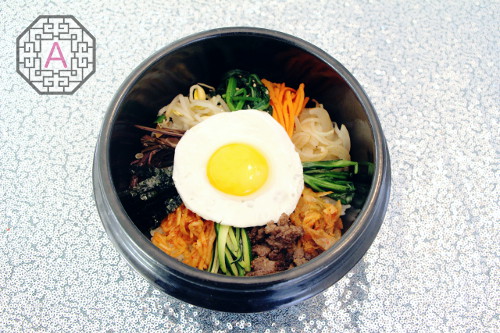
Dolsot Bibimbap is one of the most popular Korean foods among visitors to Korea. Today I will show you how to make this delicious food at home. This is my updated version of bibimbap recipe that I posted years ago. I had to delete my original bibimbap video on Youtube. To make the bibimbap video again, this time I made it even better by adding some other ingredients and show you how to make stow bowl bibimbap in details. I hope you like my upgraded version of bibimbap.
Yield: 2-3 Servings
Short Korean Lesson
- Dol (돌) = Stone
- Cheol (철) = Iron
Video Instructions
Main Ingredients:
- Some Cooked Short Grain Rice (11⁄4 Cups per Serving)
- 1 Cup Korean Radish Side (MuSaengChae)
- 1 Cup Fernbrake Side (GoSaRi NaMul)
- 1 Cup Spinach Side (SiGeumChi NaMul)
- 1 Cup Soy Bean Sprout Side (KongNaMul)
- ½ Cup Fried Kimchi
- ½ Cup Onion
- ⅓ Cup Carrot
- ⅓ Cup Zucchini
- ¼ Cup Green Onion
- 2-3 Eggs
- ½ Cup Roasted Dried Laver
- 2-3 Tbsp Sesame Oil (1 Tbsp per Serving)
Fernbrake Side Ingredients:
- 2 Cups Soaked Fernbrake
- ½ Cup Onion
- 1 Tbsp Soy Sauce
- 1 tsp Garlic, Minced
- 1 tsp Olive Oil
- 1 tsp Sesame Oil
Beef Ingredients:
- ½ Cup Ground Beef
- 1 tsp Soy Sauce
- 1 tsp Sugar
- 1 tsp Cooking Wine
- 1 tsp Sesame Oil
- ½ tsp Garlic, Minced
- 2 Pinches Salt
- 2 Pinches Black Pepper
Sauce Ingredients:
- 3 Tbsp Hot Pepper Paste
- ¼ tsp Soy Sauce
- ¾ tsp Brown Rice Vinegar or Apple Vinegar
- 1 tsp Sugar
- ¾ tsp Sesame Seeds
- ½ tsp Sesame Oil
- ½ tsp Garlic, Minced
- 1 Tbsp Water (Optional)
Directions

In my opinion, bibimbap is all about good sauce. Whatever vegetables and other sides you put in your bibimbap, the sauce makes your bibimbap taste good. To make good bibimbap sauce, mix 3 Tbsp of hot pepper paste, 1⁄4 tsp of soy sauce, 3⁄4 tsp vinegar, 1 tsp of sugar, 1⁄2 tsp sesame oil, 3⁄4 tsp of sesame seeds and 1⁄2 tsp of minced garlic. If the sauce is too thick, add about 1
Tbsp of water.
Next, let’s marinate the ground beef. In a bowl, mix ½ cup of ground beef, 1 tsp of soy sauce, 1 tsp of sugar, 1 tsp of cooking wine (optional), 1 tsp of sesame oil, ½ tsp of minced garlic, 2 pinches of salt, and 2 pinches black pepper all together.

Set it aside while you prepare the other ingredients. You can substitute the beef with mushrooms or firm tofu.

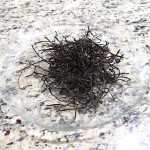
We call fernbrake ‘gosari’ in Korea. If you buy dried gosari, soak a handful in water overnight. If it is still not soft the next day, then boil it in water until it becomes soft.

We need 2 cups of softened gosari. Ready to use gosari can also be found in Korean grocery stores.
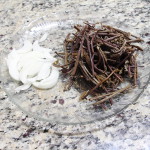
Cut the gosari into 3-inch long pieces, you can also slice up 1⁄2 cup of an onion to add to it.

In a pre-heated pan, add the gosari, onion, 1 Tbsp of soy sauce, 1 tsp of sesame oil, 1 tsp olive oil, and 1 tsp of minced garlic. Fry it for 10 minutes on medium-high. Then, the sogari namul is done.

Along with the gosari namul, I will also use about 1 cup each of musaengchae (korean radish side) and sigeumchi namul (Korean spinach side),
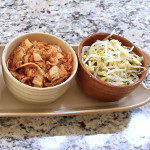
bokkeum kimchi (fried kimchi) (or chopped fresh kimchi), and kongnamul muchim (Korean soy bean sprout side) for today’s bibimbap recipe. These are typical ingredients that can normally be found in bibimbap, but seriously there is no rule for it, so you can grab whatever Korean sides or vegetables you have on hand for your bibimbap.

Now, let’s prepare some vegetable ingredients for better color, flavor, and nutrition. You can pick your favorite vegetables, but these are the common vegetables we use for bibimbap in Korea.
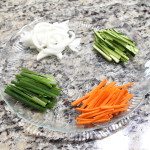
I will chop ½ cup worth of onion, cup worth of carrot, cup worth of zucchini, and ¼ cup worth of green onion into 2-inch long thin strips. The similar size of the vegetables makes your bibimbap look more neater when you assemble the dish.

Wipe a heated pan with an oiled paper towel to slightly grease the pan. Fry the onion with 1 pinch of salt for 3 minutes on medium-high.

After 3 minutes, remove the onion from the pan and do the same thing for the green onion. Fry it for 1 minute. The next one is zucchini for 2 minutes.

Fry the carrot with a pinch of salt for 2 minutes. I fried all the vegetables separately for a better appearance. However, many times, I just fry all the vegetables together at once in the same pan. For example, I start to fry the onion, then add carrot and zucchini, then add the green onion, and so on, based upon the cooking time of each vegetable.

Finally, fry the marinated beef for about 3 minutes on meidum- high.
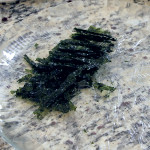
We are getting closer to the end of the preparations. Cut about ½ cup worth of roasted dried laver into thin 2-inch strips with scissors.
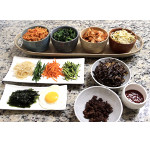
Some people add the eggs raw, but if you want them cooked, fry them now. So, all the ingredients for bibimbap are ready now. Now, it is time for the fun.

o make deliciously crispy rice on the bottom of your stone bowl, as you get in a Korean restaurant. Drizzle 1 Tbsp of sesame oil on the bottom surface of your stone bowl for bibimbap. Swill it around your bowl so that the oil will be spread out evenly on the bottom. Make sure to get the oil about 2 inches off the bottom.

Put about 1¼ cups of freshly cooked short grain rice in the bowl and spread it on the bottom. I press down gently on the rice so that it cooks better with the sesame oil and becomes crispy golden brown later.

On top of the rice, put some of each ingredient that we prepared earlier.
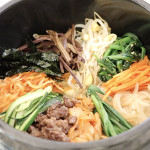
It already looks very colorful and tasty.

Put your fried egg in the center of the bowl.

Place your stone bowl on your stove top and start to cook it on high. Depending on your stove temperature, the time can be slightly different, but it should be done in 5-6 minutes. When it is almost done cooking, you will hear this sizzling sound from the bottom of your bowl. That means your rice is getting crispy.

After 5 minutes, steam will come out of the bowl with a crazy amazing smell. Put your desired amount of bibimbap sauce in your bowl.
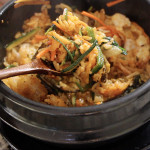
Mix everything with the sauce and eat. Please be careful not to burn your mouth. It is hot. When I mix it, I carefully leave a thin layer of rice at the bottom of the bowl undisturbed so that it continues cooking to get crispy. If you mix it into your bibimbap, you will not get much, if any, crispy rice.
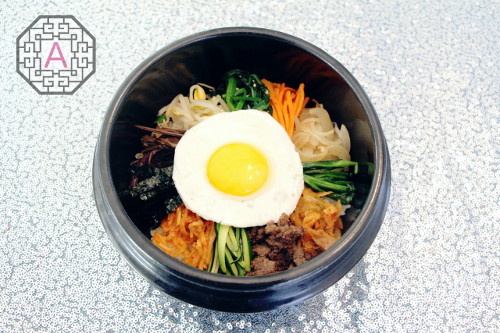
Please try my bibimbap recipe and share your story with us.



Bibimbap is one of my favorite Korean foods. It is also one of the most popular foods among “foreigners” such as me. Just looking at the ingredients, it can be difficult for me to understand why I like it so much. One of the biggest secrets of its good taste is the sauce. The gosari is also a very good ingredient to add.
Hi, honey~~
haha.. yes.. we usually think that healthy food is not taste good..but here is one of exceptions..BIBIMBAP !! ya ~~~ 😉 We can eat bibimbap again today. thanks for comment !!
p.s You got a pretty picture..cool..:D
Great pics and recipes.. looks like you got yourself a nice blog going..
Hi, Chan
wow.. are you a fatman..right ??
Thank you sooooo much for visiting my blog..hehe Happy Holidays !!! 😀
I wanted to do something different for my husbands birthday, and I found your blog with Bibimbap. The process was so easy to follow and I liked how you stated that MooSaengChae was Radish-sidedish. (Good thing to because I wouldn’t have know). Anyways, I just wanted to say thank you, becuase my husband loved it.
Hi, Payloans
Wow, I feel honor that you cooked bibimbap for your husband’s birthday and he loved it. Thank you !!! Oops, it was easy to follow ?? phew~~~ To me it’s still lots of work to make bibimbap.. hehe Happy Birthday To your husband..and Happy new year.
Hi aeris!
Thank you for another of your Great recipe. I just want to as k you if you can explain how to turn it into dolsot bibimbap?
Clari
Hi, Clari
Nice to meet you!! 😀
First, do you have a stone bowl for dolsot bibimbap? I guess you have one. Here are some tips for it.
1. On the bottom of the bowl, pour ½ Tbsp of oil and ½ Tbsp of sesame oil. Spread the oil around.
2. Put one and a half cups of hot cooked rice in the bowl. Spread it along the bottom and sides also.
3. Add all of the ingredients for the bibimbap: vegetables, meat, and so on.
4. Pour the sauce on top of it.
5. Cook it until it makes sounds. (Hard to describe it. :cry:) hm… the rice becomes a little crispy on the bottom.
6. You have to cook it for a while to get good crispy bottom. Don’t cook it on too high temperature, or the rice will burn.
Thanks !!
I did your dolsot bibimbap with a wonderful outcome: crispy rice! I send you the pic
Thank you!
Hi, Clari
Wow.. thank you for your good news.
http://www.facebook.com/photo.php?pid=30376402&l=14c3143981&id=1126082665
Hi, Clari
Good job !!!
Looks very delicious..by the way..
what is the red things under the sauce..
I looks like.. fried anchovy side-dish..is it right ?? hehe… thanks for sharing us this picture.
ahh the bibimbap looks absolutely scrumptious. hehe. I am so hungry right now. ;).
Your bibimbap recipe has my favorite banchan in it. MooSaengChae! I had ate it twice in my favorite Korean restaurant and I love it. I was looking everywhere for it, but I didn’t know the name. Thank you so much;).
If you have the time, could you please share a recipe of the dish? :).
Thank you in advance:).
oh, by the way, I have tried your kimchi recipe and I liked it fresh the most, but after a week it was still good. I think it will be better if I didn’t cheat that much with the ingredients. Where I live it is very hard to get Korean ingredients unlike Japanese and Chinese stuff. They don’t seem to have red pepper powder anywhere. But nonetheless, I will make a smaller batch the next time so I can eat it fresh.;)
Hi, Poeh
hehe.. I’m very happy that you liked your kimchi.. phew ~~ Since it’s time consuming and difficult to make.. I will feel worse if somebody try kimchi and didn’t like it..hehe thanks !!!
Yes.. I can see what you mean.. I don’t know why..maybe my taste is changed a little ?? nowadays..I prefer fresh kimchi also..hehe
thanks !!!
oh I missed the part where you had posted the recipe. My bad, sorry for asking this question.
Though I remember the radish side dish that I had eaten didn’t had an orange color but it was fairly white. Is that a different kind of side dish?
Hi, Poeh
aha..I know what you mean.. so far many people asked that dish. My husband and sister in law also liked it very much when they tried it at Korean restaurant.. yes..it’s more like radish pickle..right.. I will try to post it someday. thanks !!!
Hi Aeri,
I found your website thru youtube. I must say that you are incredible and that your husband must love eating everything you cook after filming. I enjoy very much in viewing your lessons and I can’t believe how simple it is to make this “bibimbap”. I always order it at a korean restaurant and now that I know how to make the sauce, I will use it as a veggie dip or marinate.
Thanks Aeri. Keep up the great work.
Hi, joe
Thanks for visiting my blog. haha..I can’t tell my husband love eating everything I cook..but yes..thankfully he likes most. I hope you will like this recipe if you have chance to try it. Thanks again !!! hope to see you again~~~ 🙂
[WORDPRESS HASHCASH] The poster sent us ‘0 which is not a hashcash value.
Hello Aeris !!!
HEHE yes ! I got the stone bowl in Vancouver korean store ^^ i am so happy ^^
Aeri, I was wondering how to properly clean the stone bowl? Thank you !!! 😀
Hi, Annie
haha..that’s cool. Now you can make stone bowl bibimbap at home 🙂 I’m also happy for you. hehe.. about how to handle the stone bowl.
1. Before you use for the first time, boil it in salt water for short time. like.. few minutes.. and dry it well.
2. Don’t put your stone bowl in cold water when it’s hot..then it will break.
3. Don’t use soap to clean your stone bowl. (this part, I kind of don’t like.. because.. you don’t want dirty dish ..right..hehe ) so I usually..wash it with water and cleaning towel first.. remove most of the dirty part of the bowl.. then. use really tiny amount of soap.. and try to rinse and wash it quickly..so the soap will not soaked into the stone bowl.
4. Rub the surface of the stone bowl (inside..) with a little bit of oiled paper towel for using next time.
I hope my answer helped you a little.
Thanks !!!
Hi Aeri,
It was great recipe, I never thought to make BIBIMBAP but after reading your recipe I tried to made it….and it’s so delicious, especially the sauce taste so good…….
I made it yesterday, it was so amazingly delicious! 체 친구와 저는 배가 고프다 때 까지 먹었어요! Thank you very much for the recipe, I never thought I would be able to make this dish by myself.
PS. And I am sorry for my mistakes m(._.)m
hi hemilya,
hehe no worries.. I could understand your cute Korean sentence. 😀 thanks
When I had this in Korea the bowl was always hot almost like it was cooked in the bowl. Was the bowl just heated up before the ingredients were added, or was part of it cooked in the bowl?
hi Bob,
Yes, we call that dolsot bibimbap.. they heat the stone bowl on a stove … and drizzle some oil.. sesame oil..and salt.. and spread cooked rice in a bowl… when the rice becomes hot.. add other ingredients … and before serving.. add some fresh vegetables and sauce….
Hi Aeri! So I’m going to make this and I was wondering if there is a substitute for the Red Pepper Paste?
hi simplyjvp17,
Oh.. it’s because you can’t eat spicy food.. or don’t have red pepper paste ?? red pepper paste is the most important ingredient for bibimbap.. so I don’t know what to say.. if you can’t spicy food.. there is soy sauce seasoning bibimbap.. that one can be replace of bibimbap.. you need to change the amount of soy sauce though..
My mom made this a lot when we had left overs. it really reminds me of her. thank you
[WORDPRESS HASHCASH] The poster sent us ‘0 which is not a hashcash value.
Hi Aeri,
The recipe seems easy to follow :P. ty.
I was wondering how would you make the bibimbap more spicy?
Thanks 😛
hi Sandy,
since the combination of sauce ingredients are important.. if you just increase spicy ingredient like gochujang will change the flavor for the sauce.. so i will say.. you can buy extra spicy gochujang from a store.. or double the sauce recipe..and eat the bibimbap with more sauce as my hubby does..hehe 🙂
Nice recipe 🙂 One question though, when frying the vegetables do you have to put oil on the pan everytime?
hi Ken,
yes.. not only for flavor but also for not too dry vegetable…but you can skip the oil for health or your preference too.. 🙂
Hi Aeri!
Congrats for your newly-designed layout! Looks pretty! 🙂
Well Bibimbap is one of my favorite Korean dishes and I’ve made your Bibimbap recipe over and over again, but I’ve just recently been curious about the Bibimbap sauce.
Do you think there is an “already-mixed” bibimbap sauce that I can buy? Whenever i go to a Korean restaurant and order Bibimbap, they always give me a sauce bottle with the red sauce in it and I was just wondering if that is simply just something that they mix by themselves or it’s something they bought (you know, like for example a ketchup in a burger restaurant :)).
hi Ivana,
Yes, there is an already mixed bibimbap sauce in a Korean store.. but I don’t like it.. it’s hardly close to homemade sauce. So I don’t want to recommend..but each person has different taste.. so you might like it. I think they make big portion of their own bibimbap sauce in a restaurant..and serve it in the bottle.. ^^
Hi, Aeri, i’ve been a great fan of urs,but some of urs uses beef as ingredient, due to some religious purposes, i cant have beef, instead of beef, can i use chicken?for ur cheese oven speghetti n bibimbap?bcz im interested to try both of this recipes 😛
hi Tiffany Looi,
Thanks for your comment. About your question, you can skip the beef for bibimbap.. sometimes we skip beef for our bibimbap. You can use mushroom instead of beef also. Yes, you can use chicken too. 🙂
Thanks Aeri for the answerr…cant wait to try it… 😛 😆
Hi aeriee, thank you for this recipe 😀 but it like dol sot bibimbap more!!! if i cook it on the pot how many minutes i have to cook it for? should i cook it on high heat? 🙂
hi tiffany,
YES.. usually in a restaurant.. they heat the stone bowl on high temperature.. drizzle some sesame oil… oil mixture .. maybe sprinkle a little bit of salt.. on bottom…and spread the cooked rice on it.. when the rice and bowl become hot.. they add rest of the ingredients ,,,, cook several more minutes..then serve…
이렇게 우리나라의 자랑인 비빔밥을 세상에 알리는데 힘쓰시다니, 자랑스럽습니다!
hi, casio ctk 2100
반갑습니다. ^^ 글 남겨주셔서 감사해요 ~~ ~
This is real simple yet elegant comfort food. I usually just prepare the veggies ahead to another day’s crave in tupperwares and whip it up when I want it.
Hi Aeri,
I would like to know if you can recommend for Chinese cookbooks? I have seen one or two in your videos on the bacground. If you could share some, that would be great. Thank you.
Hi Aeri,
Love your bibimbap! I want to make a bibimbap for a party of 50.
Can I cook up a large pan, mix it and leave for an hour without it drying out? If it will dry out, is there something I can add to keep it tasty and moist?
Thank you for your cooking tips. Love your food.

Hi Aeri,
Your site is really helpful! Thanks 😉
I was wondering if it’s necessary to put the gosari in bibimbap….
hi Vivian,
You can skip gosari.. ^^
i made this two days ago and my boyfriend and i LOVED it so much! so when i came home from a bad day of work, all i could think of was “a nice bowl of bibimbap will fix everything” hehe and DID IT?! it was so good! my boyfriend asked me to make him some as well!
i love your bibimbap recipe, aeri! it’s heaven sent! it’s my new favorite! 😀
😮 so delicious but so much work! I think I’ll get in my car and go k-restaurant, I love bi bim bap in a stone bowl with crispy rice and then crack a raw egg and mix it up …… Heaven!
Hi Aeri. Can I find gosari in Chinese supermarkets?
Thanks 😛
hi Benjamin,
well..i think it’s depend on the Chinese grocery store.. because..even some Korean grocery stores don’t sell gosari..^^ thanks
Congratulations!
Wonderful presentation you got there.
Hi! Is gosari a kind of mountain root?
hehe
Hi Aeri,
lovely video and nice presentation. I do not have GoChuJang at home. Can this be replace with any other chilli sauce like sambal oelek?
Thanks
hi Ashima,
Sorry I don’t know what is sambal oelek like.. so can’t answer your question weill. This dish’s the most important part is the sauce.. and gochujang has own unique flavor .. so if you can get.. I recommend you try gochujang..and if you can’t.. and still want to try that chili sauce you have.. and please try and let me know how it turned out. sorry for poor answer again.
I learned a nice way to do this from a restaurant owner. If you are making dolsot bibimbap, and you like the crispy rice on the bottom (as I do), you can make it as follows. First, you need a lid that fits your dolsot well enough to make a seal (keeps the steam inside). Put a teaspoon or two of sesame oil in the bottom before you put the rice and everything in. The last ingredient you put is a raw egg, on top of the other stuff. We usually make a basin of sorts with the vegetables, etc., to hold the raw egg. Cover with the lid and heat the bowl over a medium flame. When the egg white begins to show signs of cooking (i.e., it turns from clear to opaque white), the bibimbap is ready to serve. If you use too high of a flame, the crispy rice on the bottom will be burned; you need just enough heat to make it brown when the egg is cooked.
Dear Reader,
The technique I learned was to heat the dolsot with only sesame oil and the rice, and assemble the rest once the rice begins to sizzle. That puts the cook in a bit of a time-crunch! I like your way better….
Thank you,
Brian
I tried this recipe tonight, for me and my boyfriend, and we found it so delicious, and filling! I will absolutely do this recipe again. I didn’t have all the main ingredients nor the gosari, but it turned out nice.
I used sriracha sauce instead of the red pepper paste and it was good
I’m so happy I found your blog 😀
Hi, I also like the dolsot bibimbap with the crispy rice. As I am still in Korea, is a dolsot a special pan that I can purchase here? Where would you go to purchase one? Would Lotte Mart or E-mart have them?
Sherry
hi Sherry,
we brought this stone bowl from Korea.. I’m not sure where you can buy this in usa.. sorry for poor answer..
Hi, Sherry,
I found dolsots for sale at a store in the Namdaemun market. Don’t forget to buy the coaster, or you’ll never get the pot to the table!
The hardest part for me–which I’m sure will improve with practice–is assembling all the vegetables quickly once the pot and the rice are sizzling.
Enjoy!
Dear Aeri, I have made Bibimbap several times already, always using your recipe as a guide. Thank you so much for sharing, I will definitely be making it again and again. I have just posted the delicious result on my blog, here:
http://testadoprovadoeaprovado.blogspot.com.br/2009/12/bibimbap-goodbye-korea.html
Please come and take a look, I would love to hear your feedback 🙂
All the best,
Renata
Hi, Aeri,
I have lived several times in Korea for brief periods. Bibimbap has always been one of my favorite dishes….I am so glad to have found your recipe. Aside from the extensive preparation, it is really easy, and SO delicious! Thanks for posting videos of the process, too!
I love your site and have shared it with many friends. For the record, your English is very good–much better than my Korean!
Thank you,
Brian
This is absolutely wonderful. I’m making this tonight, for sure!!
Thanks for your recipe. I used pork mince, but its really good,especially the sauce. Love Bibimpap..
hi Annie Nguyen,
Good job..and thanks for trying my recipe. 🙂
It was sooo incredibly delicious and simple! My first korean experience at a restaurant was bibimbap, and they served it in a hot stone bowl with a raw egg on top so the egg would cook around the grains as you mix. Now that I’ve been conquered by your bibimbap, I think I might invest in those stone bowls! Here is a picture of my bibimbap following your recipe! http://instagram.com/p/hR7Lr9MI2U/. Thank you so much, your website is awesome!
hi Sunny,
That’s so lovely looking bibimbap. Thank you very much for sharing the pic with me. 🙂
hi aeri! i love your site. i am looking for a bibimbap recipe to try and this one looks good. i have a question though — in a cookbook i have, it is called “bimbim pap” – is there a difference?
hi amanda,
Thanks for your comment. Bibim pap is the same thing with bibimbap.. it’s just different way of romanized Korean words ^^:; Thanks
Hi, can i use white vinegar instead of brown rice vinegar or apple vinegar? All i have at home is white vinegar.
hi Lenach,
Yes, you can use white vinegar you have at home. 🙂 Thanks
Hello Aeri !
I tried this recipe too and it was a success !!! Thanks a lot !
I really like your website and your recipes ! <3
Keep it up ! =)
Hi Sarahime,
That’s awesome. Thanks for your comment. ^^